Portal Glastonbury
Ref.WD0532
Ref.WD0532
Couldn't load pickup availability
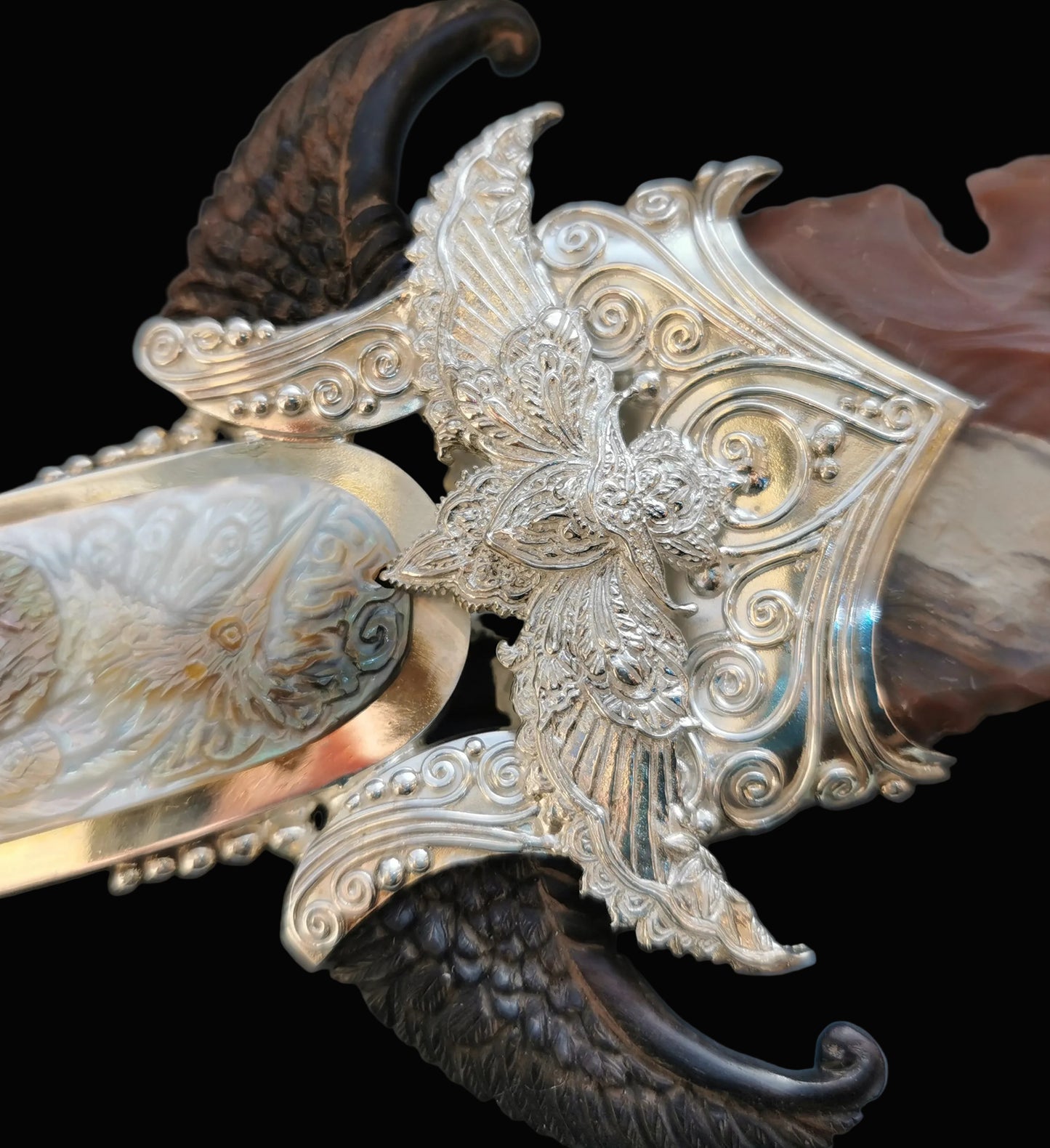
Ref.WD0532 - Silver wand with raven skull [pommel], turquoise, carnelian, mother of pearl carved Tibetan cloud motifs, labradorite carved dragon, mother of pearl carved phoenix, sono wood [guards], silver owls, lapis lazuli, and hand chipped jasper spear head [blade].
Dragons symbology has evolved from traditional mythologies with additional layers that align with modern spirituality as:
• Transformation and Personal Growth: Dragons often symbolize profound transformation, akin to the shedding of skin seen in their serpentine relatives, focusing on personal evolution, spiritual awakening, and enlightenment.
• Wisdom and Knowledge: In many cultures, dragons are symbols of ancient wisdom and knowledge. In modern spirituality, this represents the pursuit of higher knowledge, esoteric wisdom, or the uncovering of hidden truths.
• Guardianship and Protection: Dragons are frequently protectors in mythology. In modern spirituality they might guard not just physical treasures but also spiritual or esoteric knowledge, offering protection to those on a spiritual quest.
• Power and Strength: The dragon's inherent power reflects personal empowerment, inner strength, and the ability to overcome challenges. This can inspire individuals to harness their own 'dragon energy' for overcoming obstacles.
• Elemental Mastery: Dragons are often linked to the elements (fire, water, air, earth), symbolizing mastery over natural forces, and likewise can relate to mastering one's own energies or chakra system.
• Kundalini Energy: In some interpretations, the dragon symbolizes the Kundalini energy, which lies dormant at the base of the spine and, when awakened, rises through the chakras, representing spiritual awakening and the unification of spirit and matter.
• Balance of Yin and Yang: Particularly in Eastern symbolism, dragons often represent the yang (masculine, active) aspect, which when paired with the yin (feminine, passive, often represented by the phoenix), symbolizes balance and harmony in life.
• Creativity and Manifestation: The dragon's breath, often fire, can symbolize creativity, the spark of life, and the power to manifest desires or to bring forth ideas into reality.
• Spiritual Guides: Dragons can act as spiritual guides or totems, leading individuals through life's journeys, providing insights, or warning of dangers.
• The Shadow Self: In psychological terms, dragons might symbolize the 'shadow' self or the parts of ourselves we fear or suppress, encouraging exploration and integration of these aspects for wholeness.
• Immortality and Eternity: Due to their association with ancient lore and their mythical longevity, dragons can symbolize immortality, the eternal soul, or the cyclical nature of life.
• Alchemy: Dragons in alchemy represent the prime matter, the chaos, or the unrefined potential that the alchemist seeks to transform into something purified or enlightened.
• Cultural Fusion: The dragon's symbolism has been adopted and adapted globally, making it a universal symbol in modern spiritual thought, representing unity and the blending of different spiritual paths.
• Healing: Some practitioners see dragons as having healing energies, especially in the context of energy healing or crystal therapy, where dragons might be invoked for their protective or transformative powers.
Dragons are not just creatures of lore but are symbols imbued with deep spiritual significance, encouraging personal growth, spiritual exploration, and the integration of ancient wisdom with modern spiritual practices.
Raven medicine, in a spiritual context, often symbolizes several key concepts rooted in various cultural and indigenous teachings:
Transformation and Adaptability
Ravens are renowned for their adaptability, thriving in diverse environments from forests to urban landscapes. This adaptability is a profound metaphor for human life, where change is inevitable. Raven medicine teaches:
Flexibility in Thought and Action: Embracing change not just as a necessity but as an opportunity for growth. It encourages one to be versatile, to pivot when necessary, and to see transformation as a natural, beneficial part of life.
Personal Evolution: Like the raven shedding feathers, one might shed outdated beliefs or behaviors, fostering personal evolution. This aspect of raven medicine highlights the journey of self-discovery and self-reinvention.
Magic and Mystery of the Mundane
The raven's association with magic in this context isn't about spells or otherworldly forces but about:
Recognition of Life's Wonders: Finding magic in the everyday, in the patterns of nature, or in human connections. It's about seeing the world with a sense of awe, recognizing that there's always more than meets the eye.
Unraveling Mysteries: Encouraging curiosity and an open mind, teaching us to explore the unknown parts of ourselves or the world around us. Ravens are intelligent, solving complex problems, which symbolizes the quest for knowledge and understanding.
Insight, Intuition, and Inner Wisdom
Listening to Inner Voices: Ravens are thought to carry messages, but in this context, it's about listening to one's own intuition or the subtle cues from nature or life. It's about inner wisdom that doesn't rely on external validation but on personal insight.
Deepening Self-Understanding: Engaging with one's subconscious through dreams, meditation, or simply quiet reflection. The raven's black feathers might symbolize delving into the depths of one's psyche to bring to light hidden truths or talents.
Creativity and Innovation
Innovative Thinking: Ravens are known for their problem-solving skills, symbolizing creativity in overcoming life's challenges. This aspect encourages us to think outside the box, to create, and to find new paths or solutions.
Artistic Expression: The raven's connection to creativity might inspire one to explore art, writing, or any form of self-expression as a way to understand and heal oneself or to share one's inner world with others.
Healing Through Nature and Self
Natural Healing: Without invoking divine powers, the raven's medicine can be seen in the healing properties of nature, encouraging us to spend time outdoors, to learn from natural cycles, and to heal through connection with the earth.
Self-Healing: Recognizing that healing often starts from within, with an understanding of one's own needs, rhythms, and the courage to change or let go of what no longer serves.
Balance and Integration
Embracing Duality: Ravens, with their stark contrast, teach about the balance of light and dark within us and in life. They remind us that all emotions, experiences, and aspects of life are valid and necessary for a holistic existence.
Integration of Life's Lessons: Learning from both the highs and lows, understanding that life's contrasts offer opportunities for learning and growth.
Messenger of Awareness
Nature's Voice: Without attributing divinity, ravens can still be seen as messengers from nature, urging us to pay attention to our environment, to ecological issues, or to the subtle shifts in our personal lives.
Self-Awareness: They might symbolize the need to communicate with ourselves, to listen to our body’s messages, or to heed the signs that we might be ignoring in our daily hustle.
This expanded view of raven medicine emphasizes personal, spiritual growth through observation, adaptation, and a deep connection with the natural world and one's inner self, without reliance on external spiritual entities.
The phoenix is a transcendent symbol revered across cultures, embodying renewal, resurrection, and immortality. This mythical bird, which bursts into flames only to rise reborn from its ashes, encapsulates the eternal cycle of death and rebirth. Its rich symbolism resonates deeply, offering profound spiritual, cultural, and psychological insights into the human experience.
Transformation and Rebirth: The phoenix represents the ability to overcome profound adversity, emerging revitalized after destruction. It reflects personal growth, reinvention, and the resilience to embrace new chapters, making it a powerful metaphor for individuals recovering from trauma or societal upheavals seeking renewal.
Eternal Life and Immortality: Its cyclical rebirth connects it to themes of eternal life, the soul’s enduring nature, and spiritual transcendence. Often tied to divine or cosmic forces, the phoenix symbolizes the persistence of existence beyond physical death, inspiring awe and contemplation.
Hope and Renewal: As a beacon of optimism, the phoenix symbolizes hope amid despair, promising fresh beginnings after loss. Its story uplifts those facing dark times, offering a vision of light and possibility.
Fire and Purification: The flames of the phoenix signify purification, consuming the old to make way for the new. This process is often linked to spiritual cleansing, emotional healing, or transformative growth, where destruction becomes a catalyst for creation.
Strength and Resilience: Rising triumphantly from its ashes, the phoenix embodies unwavering endurance and the capacity to conquer challenges. It serves as an emblem of inner fortitude and the human spirit’s ability to thrive against all odds.
Cultural Contexts:
Greek and Roman Mythology: Described by Herodotus and Ovid, the phoenix symbolized renewal and the soul’s eternal essence. Its connection to the sun’s daily cycle underscored themes of continuity and regeneration.
Chinese Mythology: The fenghuang, a phoenix-like creature, symbolized virtue, harmony, and balance. Often paired with the dragon, it represented imperial power, feminine grace, and the union of yin and yang.
Alchemy: In alchemical traditions, the phoenix represented the philosopher’s stone, the process of spiritual refinement, and the attainment of enlightenment, symbolizing the transformation of base elements into divine essence.
Modern Symbolism:
In contemporary contexts, the phoenix remains a potent symbol in literature, film, and pop culture. In J.K. Rowling’s Harry Potter, Fawkes the phoenix heals with tears and regenerates, embodying loyalty and renewal. In Marvel’s X-Men, Jean Grey’s transformation into the Phoenix represents both destructive power and redemptive rebirth. Beyond fiction, the phoenix inspires real-world metaphors, such as cities rebuilding after disasters (e.g., Atlanta’s resurgence after the Civil War) or individuals recovering from personal crises. It symbolizes societal renewal, personal transformation, and the enduring human spirit’s capacity to rise above adversity.
The phoenix’s universal appeal lies in its ability to speak to both individual and collective experiences, offering a timeless narrative of hope, resilience, and the transformative power of renewal. Its image continues to inspire art, literature, and personal journeys worldwide.
Owl medicine draws on the owl's deep symbolism in many indigenous cultures, where it's revered as a creature of mystery, wisdom, and mysticism. Here's how owl medicine manifests:
Wisdom and Insight: Owls symbolize profound wisdom, encouraging the pursuit of hidden truths and understanding beyond superficial layers. This aspect of owl medicine teaches one to learn from life's experiences and to see through deceptions.
Intuition and Psychic Abilities: With their silent wings and nocturnal nature, owls represent intuition and psychic insight. Owl medicine inspires confidence in navigating the unknown, trusting one's instincts, and developing latent psychic abilities.
Silent Observation: Owls excel at silent observation, advocating for a life where one listens more than speaks and observes rather than reacts. This teaches the value of perception and reflection in learning from one's environment.
Protection and Guidance: In some cultures, owls are guardians or spiritual guides, particularly during transitions or when facing life's mysteries. Owl medicine provides a sense of protection and guidance, helping one navigate through the unknown.
Mystery and Magic: The owl's nocturnal life links it to the mystical realms, promoting the exploration of the unseen, the subconscious, and the spiritual. Owl medicine encourages embracing life's mysteries and recognizing magic in daily experiences.
Change and Transformation: Symbolically, owls relate to death and rebirth, representing the end of old ways and the beginning of new ones. During times of change, owl medicine can be a guide through personal transformation.
Healing through Insight: While not directly linked to physical healing, owl medicine aids in healing by providing clarity and understanding, which can be profoundly therapeutic.
Connection to the Ancestors: Owls are sometimes seen as messengers or embodiments of ancestors, offering a way to connect with ancestral wisdom or seek guidance from those who have passed.
Owl medicine, therefore, is about harnessing these owl qualities for personal growth, wisdom, and to delve into life's deeper mysteries. It involves using owl symbols in rituals, meditations, or daily life to enhance one's intuition, understanding, and spiritual connection. Owl feathers or the owl itself might be utilized in ceremonies to invoke these medicinal aspects.
Size: 311mm/12.24in