Portal Glastonbury
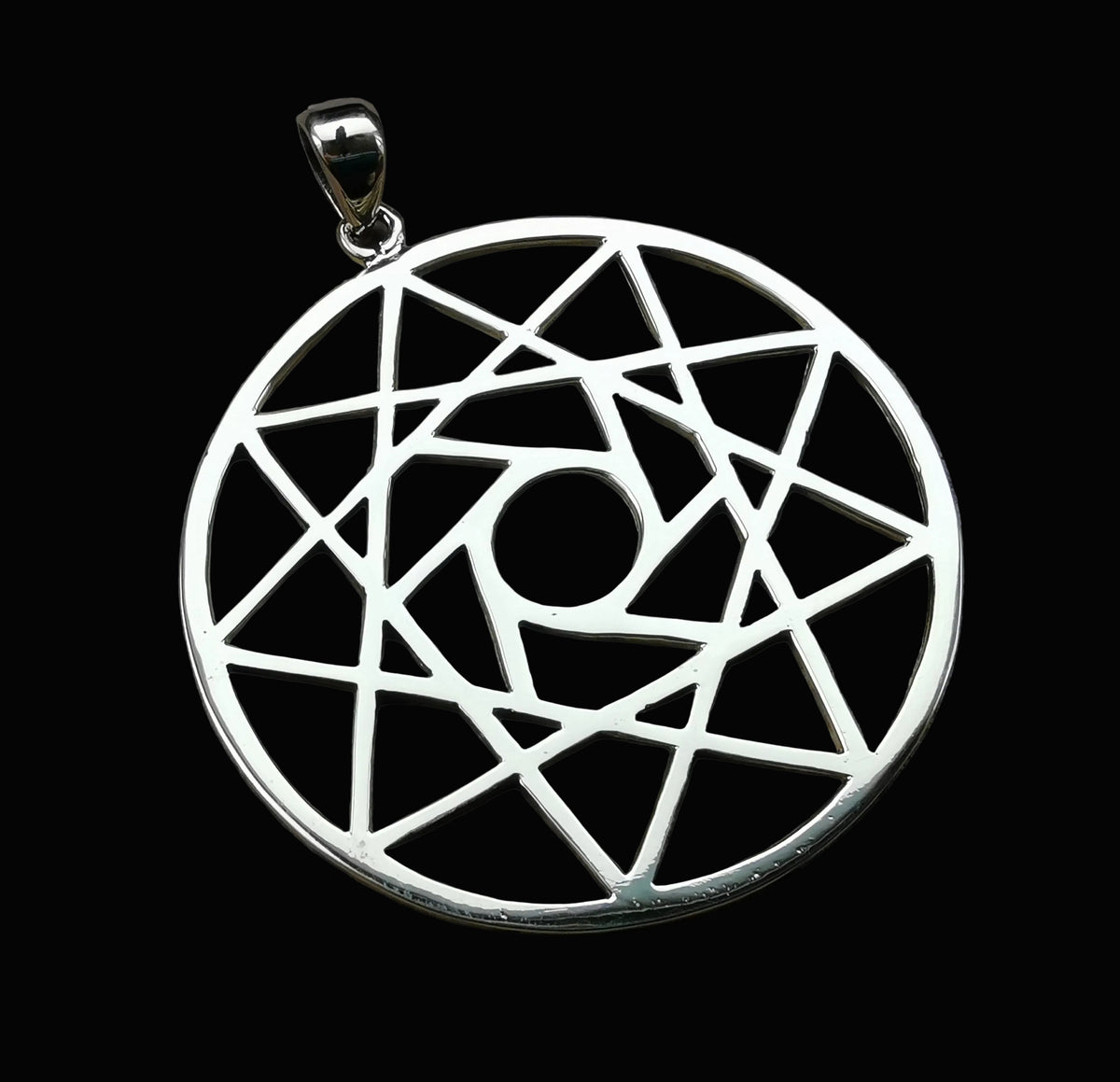
Ref.SM0086 - Enneagram w/ circle
Ref.SM0086 - Enneagram w/ circle
Couldn't load pickup availability
Ref.SM0086 - Enneagram w/ circle
The Enneagram, a nine-pointed geometric figure (from Greek "ennea" meaning nine and "gramma" meaning drawn or written), consists of a circle enclosing an equilateral triangle and an irregular hexagram. It symbolizes universal laws, human consciousness, and pathways for transformation, blending ancient wisdom with modern psychology. Often viewed in sacred geometry and spiritual contexts, it represents unity, cyclical processes, and the interplay of forces in creation and personal evolution. While its exact origins are disputed—tracing to influences like Pythagoras, Kabbalah, Sufism, and early Christian mystics—the modern form emerged in the 20th century via G. I. Gurdjieff, Oscar Ichazo, and Claudio Naranjo. It serves as a tool for self-awareness, illustrating how ego distortions obscure essence, and guides toward enlightenment and wholeness. The Enneagram also highlights the dynamic nature of personality as a spectrum rather than fixed traits, encouraging ongoing self-reflection to uncover blind spots and foster authentic relationships.
Key Symbolic and Metaphysical Significances
- Unity, Wholeness, and Infinity: Embodies oneness and eternal cycles, reflecting the interconnectedness of all existence and the boundless nature of reality. It encourages transcending ego limitations to embrace a larger, expansive self, promoting a sense of integration with the world.
- Transformation and Personal Evolution: Maps the journey from distorted passions (e.g., anger, pride) to virtues and higher ideas, symbolizing inner alchemy and restoration of essence through self-observation, growth, and behavioral shifts. This process aids in breaking habitual patterns for greater freedom and adaptability.
- Balance of Forces and Creation: Illustrates dynamic laws governing change, highlighting how active, passive, and reconciling energies resolve stagnation and foster harmony in life processes, such as decision-making or creative endeavors.
- Self-Awareness and Interconnectedness: Reveals unconscious patterns, nine personality archetypes, and their relations, promoting empathy, psychological insight, and collective harmony. It underscores how individual traits influence group dynamics, enhancing communication and conflict resolution.
Components and Their Symbolism
- Circle: Unity, eternity, and the law of one; a boundary for personality, inviting expansion beyond conditioning and toward broader perspectives.
- Triangle (Points 3,6,9): Law of three—forces of affirmation, denial, and reconciliation; tied to centers of intelligence (thinking, feeling, instinct), representing balanced cognition and action.
- Hexad/Hexagram (Points 1-4-2-8-5-7): Law of seven—cyclical transformation, spectrums (e.g., colors, notes), and non-linear progress; linked to arithmetic patterns like 1/7 decimal, illustrating evolutionary loops in personal and systemic development.
Cultural and Historical Meanings
Roots in ancient Egypt, Babylon, Pythagorean philosophy, Kabbalah's Tree of Life, Sufism, and early Christian mysticism (e.g., Evagrius Ponticus's vices/virtues). Modern adaptations include Gurdjieff's Fourth Way for self-development and Ichazo's psycho-spiritual system. Across cultures, it signifies perfection (number nine as completion), energy centers (chakras), and universal archetypes, influencing art, literature, and therapeutic practices.
Practical Uses and Considerations
Used in meditation, therapy, coaching, and leadership for personality typing (nine types with wings, subtypes), stress/integration paths, and personal awakening. Tests like RHETI aid identification, though validity varies. Approach subjectively for growth, combining with journaling or group discussions for deeper insights, as claims lack full empirical backing but offer practical value in everyday self-improvement.
Material: brass
Size: 49mm/1.93in approx.