Portal Glastonbury
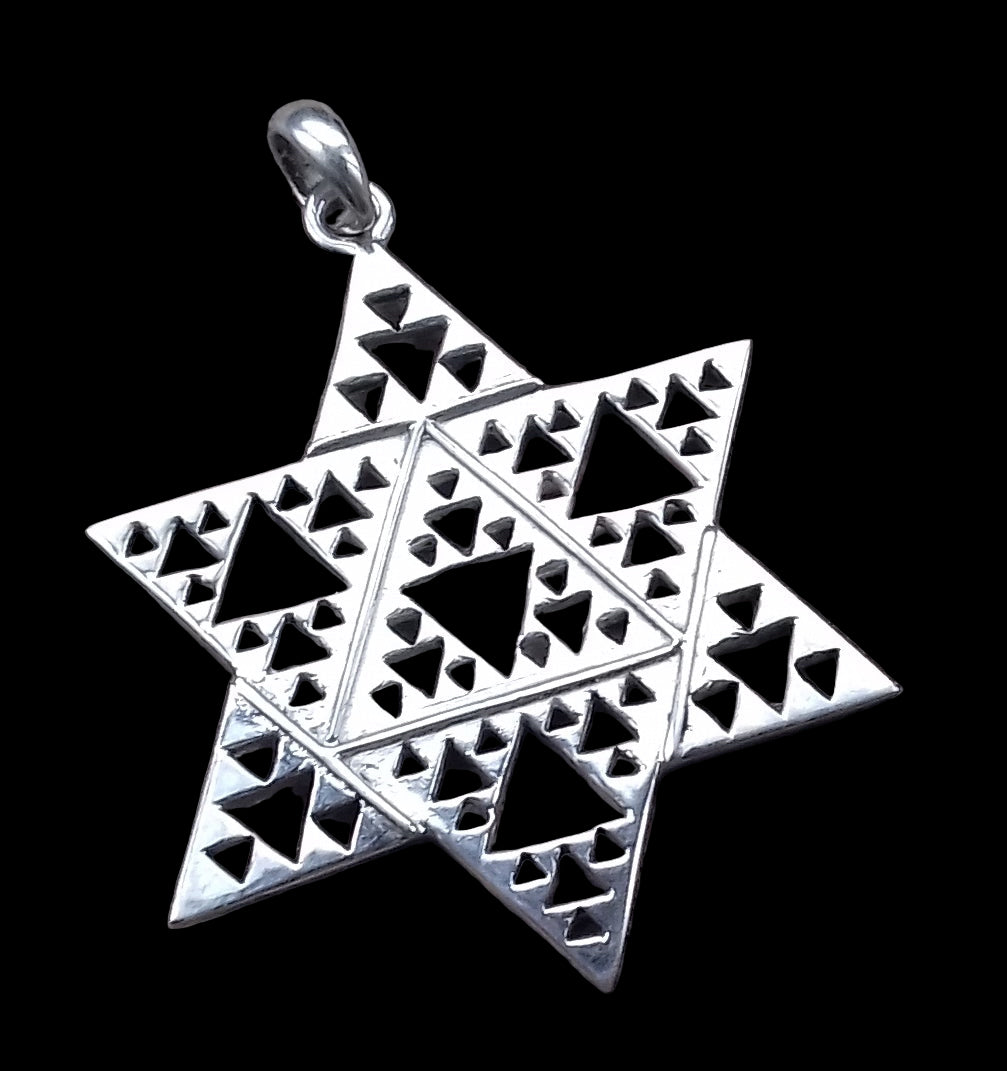
Ref.SM0061 - Sierpinski triangle
Ref.SM0061 - Sierpinski triangle
Couldn't load pickup availability
Ref.SM0061 - Sierpinski triangle
The Sierpinski triangle, a fractal geometric pattern named after mathematician Wacław Sierpiński, holds spiritual significance in various philosophical and mystical traditions, particularly within the realm of sacred geometry and fractal theory. It is constructed by starting with an equilateral triangle and recursively removing smaller inverted triangles from its center, creating a self-similar structure that repeats at every scale. This process results in a shape that appears infinitely complex yet is built from simple, repeating rules, symbolizing themes of unity, infinity, interconnectedness, and the emergence of complexity from simplicity.
### Fractal Self-Similarity and the Illusion of Separation
At its core, the Sierpinski triangle embodies self-similarity, where each smaller segment mirrors the whole structure, no matter how deeply one zooms in. Spiritually, this represents the idea that individuality is an illusion; every part of existence is a reflection of a larger whole, fostering a sense of interconnectedness among all things. In meditative practices or philosophical contemplation, the triangle can serve as a visual aid to dissolve perceived boundaries, encouraging one to recognize patterns repeating across personal experiences, relationships, and the natural world. For instance, just as the triangle's voids create space within solidity, it symbolizes the balance between presence and absence, reminding practitioners that emptiness or "negative space" in life—such as moments of stillness or loss—contributes to overall harmony and growth. This self-replicating quality also mirrors how personal habits or thoughts propagate through one's life, suggesting that small, intentional changes can lead to profound, expansive transformations over time.
### Infinity and the Eternal Cycle of Expansion
The infinite recursion in the Sierpinski triangle—where the pattern continues indefinitely without resolution—evokes concepts of eternity and boundless potential. Spiritually, this fractal nature is seen as a metaphor for the endless journey of self-discovery and enlightenment, where each layer of understanding reveals deeper insights, much like peeling an onion with no core. It encourages a mindset of continuous evolution, where personal growth is not linear but iterative, building upon itself in cycles of refinement. In esoteric traditions, such fractals are linked to the concept of "as above, so below," illustrating how microscopic patterns (like cellular structures) echo macroscopic ones (like galaxies), promoting a holistic view of the universe as a unified, ever-expanding system. This can inspire meditative visualizations where one imagines descending through the triangle's levels to access subconscious layers, fostering inner peace and a sense of timelessness.
### Connection to Consciousness and Mental Clarity
The triangle's structure is often associated with the power of consciousness, as the equilateral triangle itself symbolizes clarity, focus, and the integration of mind, body, and spirit. In fractal form, the Sierpinski variant amplifies this by representing the fractal nature of thought processes—how a single idea can branch into infinite variations, mirroring neural networks or the expansion of awareness. Philosophically, it serves as a tool for enhancing mental acuity, encouraging individuals to "zoom out" from chaotic thoughts to see underlying patterns, much like how the triangle maintains coherence despite its complexity. This can be applied in mindfulness practices, where contemplating the shape helps cultivate detachment from ego-driven narratives, promoting a state of flow and heightened perception. Furthermore, its emergence from random processes (like the chaos game, where points are plotted iteratively) underscores the spiritual notion that order can arise from apparent disorder, inspiring resilience in facing life's uncertainties.
### Harmony with Natural Patterns and Universal Order
In sacred geometry, the Sierpinski triangle is viewed as a blueprint for natural phenomena, appearing in patterns like coastlines, clouds, or biological structures (e.g., fern leaves or blood vessels), which exhibit self-similar scaling. Spiritually, this connection highlights the inherent order in the universe, suggesting that human existence is part of a larger, harmonious design where simplicity begets beauty and complexity. It can evoke a sense of awe and belonging, as observing these fractals in nature reinforces the idea that personal struggles or achievements follow similar recursive laws, leading to balance and equilibrium. In architecture or art, incorporating the pattern (as seen in historical decorative motifs predating Sierpiński) is believed to infuse spaces with vibrational energy that promotes tranquility and alignment.
### Philosophical and Transformative Implications
Beyond symbolism, the Sierpinski triangle challenges conventional perceptions of dimension and reality, existing in a fractional dimension (approximately 1.585) between a line and a plane. This "in-between" quality spiritually signifies liminal states—transitions in life, such as personal rebirth or shifts in perspective—encouraging adaptability and openness to ambiguity. Philosophers and mystics interpret it as a map for enlightenment paths, where the removal of central triangles represents shedding illusions or outdated beliefs to reveal deeper truths. In personal development contexts, it inspires rituals or visualizations for manifesting goals, as the iterative process mirrors building habits through repetition, ultimately leading to a more integrated self. Overall, its spiritual essence lies in bridging the finite and infinite, inviting profound reflection on one's place within the vast tapestry of existence.
AFTER GROK
The symbolic significance of the Sierpinski triangle, a fractal and self-similar geometric pattern, lies in its mathematical elegance and its ability to evoke profound metaphysical and philosophical ideas. Named after Polish mathematician Wacław Sierpiński, who described it in 1915, this shape—formed by recursively removing smaller triangles from an equilateral triangle—carries layered meanings that resonate across science, spirituality, and human thought.
At its core, the Sierpinski triangle symbolizes infinity and the concept of the infinite within the finite. Its structure reveals an endless process: no matter how deeply you zoom in, the pattern of triangles within triangles repeats indefinitely, suggesting boundless complexity contained within a simple, bounded form. This mirrors ideas of the universe as both vast and intricate, where the macrocosm (the whole triangle) reflects the microcosm (its smaller parts), a concept central to mystical traditions like Hermeticism or Eastern philosophies.
The fractal nature of the Sierpinski triangle also represents unity and interconnectedness. Each smaller triangle is a scaled-down version of the whole, implying that every part is linked to the greater structure. This resonates with spiritual notions of oneness—individual elements reflecting the universal whole, as seen in ideas like the interconnected web of life where each node mirrors the entire cosmos.
Another layer of symbolism is complexity emerging from simplicity. The Sierpinski triangle starts with a basic rule—divide and remove—and from this minimal process arises an intricate, almost paradoxical form with infinite detail and a fractional dimension (approximately 1.585). This evokes the idea that profound outcomes can stem from simple beginnings, paralleling creation myths or the notion that the universe unfolded from a singular point, like the Big Bang.
The triangle’s self-similarity also suggests cycles and continuity. It symbolizes resilience and permanence through repetition, as the pattern persists regardless of scale. In a spiritual sense, this can reflect the eternal nature of existence, where change and transformation follow consistent principles, akin to the cycles of life, death, and rebirth.
In esoteric contexts, the Sierpinski triangle aligns with sacred geometry, where shapes encode universal truths. Its triangular base connects to the symbolism of the triangle itself—stability, balance, and the trinity (e.g., mind, body, spirit). The recursive voids within it might symbolize the interplay of presence and absence, matter and emptiness, echoing philosophical ideas about reality’s dual nature or the void as a source of creation.
Psychologically, the Sierpinski triangle can represent the layers of the self. Its infinite regress invites introspection, suggesting that exploring one’s identity reveals deeper, repeating patterns—habits, beliefs, or truths—that mirror the larger whole of one’s being. It’s a call to look within, embracing both complexity and coherence.
In modern contexts, the Sierpinski triangle also symbolizes the beauty of chaos and order coexisting. As a fractal, it bridges deterministic rules (the recursive process) with unpredictable intricacy, reflecting how life balances structure and freedom. This makes it a potent emblem for creativity, adaptability, and the harmony of opposites.
Ultimately, the Sierpinski triangle’s symbolic significance lies in its ability to evoke wonder at the infinite, the interconnected, and the elegantly complex. It stands as a visual metaphor for the universe’s depth, the unity of all things, and the profound patterns that underlie both nature and human consciousness.
Type: medallion
Material: silver
Size: 40mm/1.57in approx.