Portal Glastonbury
Ref.PD1211
Ref.PD1211
Couldn't load pickup availability
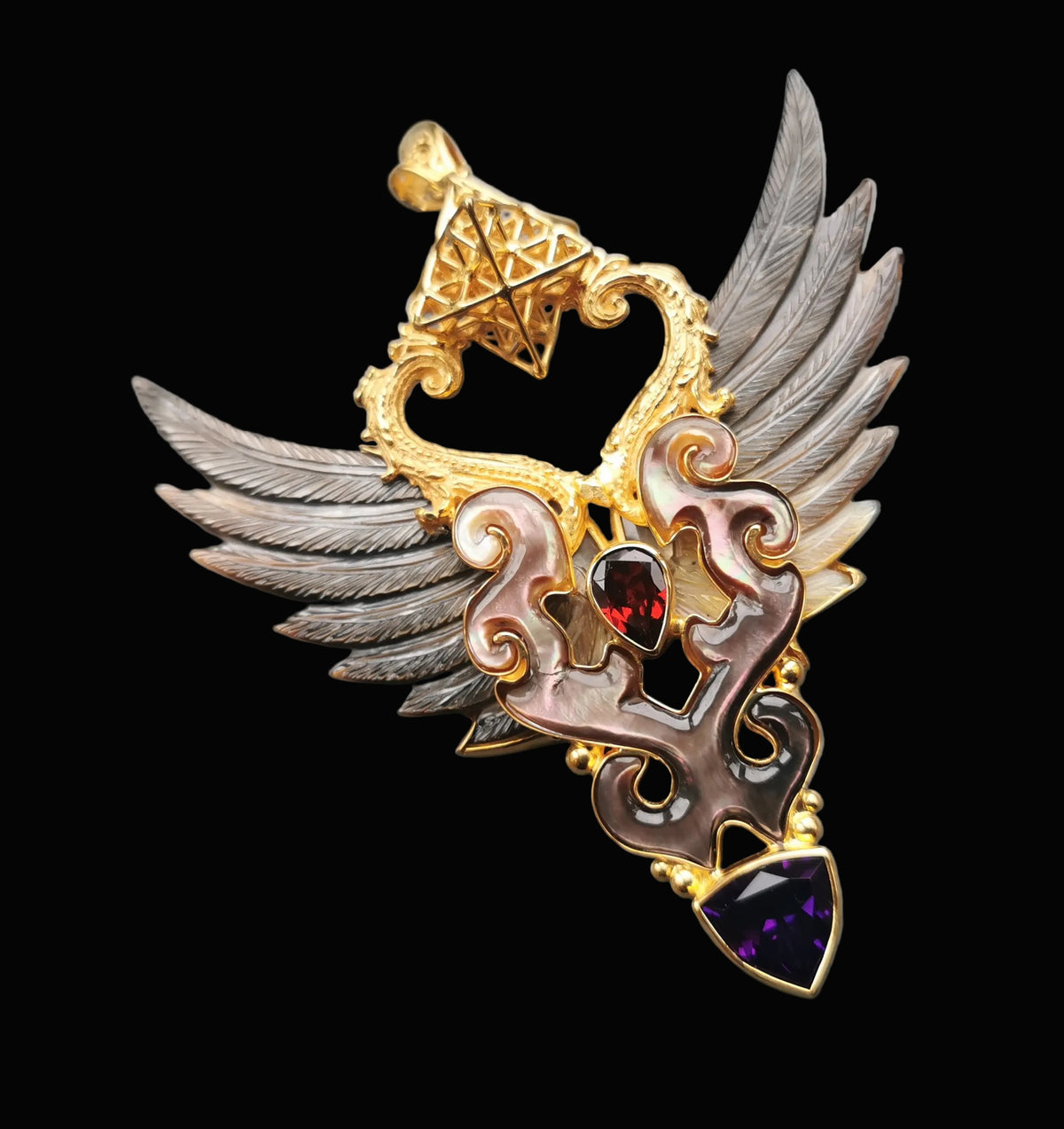
Ref.PD1211 - Gold plated on silver pendant with Tantric Matrix geometry, mother of pearl carved wings & clouds, garnet, and amethyst gemstones.
Wings are often imbued with profound meaning:
- Spiritual Transcendence: Wings symbolize the soul's journey towards higher consciousness or enlightenment, representing the aspiration to rise above the mundane or material world.
- Freedom: They signify liberation from earthly constraints, whether those are physical, emotional, or spiritual bonds.
- Protection: Often seen as a sign of spiritual protection, offering comfort and a sense of safety on one's spiritual path.
- Transformation: Like the metamorphosis of a caterpillar into a butterfly, wings represent personal transformation, rebirth, or the shedding of old ways to embrace new growth.
- Connection Between Worlds: Wings can symbolize the ability to move between different realms or states of existence, bridging the earthly with the spiritual, the known with the unknown.
- Empowerment: They embody the idea of gaining strength or power, often related to overcoming challenges or achieving personal empowerment.
- Healing: In some interpretations, wings are associated with healing energies, suggesting the capacity to heal oneself or others through spiritual means.
- Manifestation: The act of spreading wings can be seen as a metaphor for manifesting one's dreams or desires, taking flight towards one's goals.
- Intuition and Insight: Wings might also represent heightened intuition or insight, the ability to 'fly' above situations for a broader perspective.
These symbols encourage individuals to seek personal growth, embrace change, and connect with their higher selves or Spirit. Wings are not just about physical flight but about the journey of the soul.
Clouds, as natural phenomena, carry rich symbolic significance across cultures, art, literature, and psychology, shaped by their transient forms, ethereal nature, and role in weather patterns. Their symbolism focuses on human experiences, emotions, and natural cycles.
1. Transience and Impermanence
Core Symbolism: Clouds are ever-changing, forming and dissolving quickly, making them a universal symbol of impermanence and the fleeting nature of life, emotions, or moments.
Cultural Contexts:
In Buddhism, clouds embody anicca (impermanence), illustrating that all things pass, like clouds drifting across the sky, encouraging mindfulness of the present.
In Japanese haiku and art, clouds evoke mono no aware, a bittersweet appreciation of life’s ephemeral beauty, capturing fleeting moments.
Example: In poetry, a drifting cloud might symbolize a transient emotion, urging one to cherish the moment before it fades.
2. Mystery and the Unknown
Core Symbolism: Clouds obscure the sky, hiding what lies beyond, symbolizing mystery, ambiguity, or the unknown. Their shapeshifting forms spark imagination and subjective interpretation.
Cultural Contexts:
In Western art (e.g., Romantic landscapes), clouds create atmospheric depth, suggesting unexplored realms or introspective uncertainty.
In psychology, clouds in dreams or art therapy may represent unclear thoughts or unresolved questions, their forms open to personal meaning.
Example: The phrase “head in the clouds” reflects dreaminess or detachment, tying clouds to the intangible realm of ideas and possibilities.
3. Emotion and Mood
Core Symbolism: Clouds mirror emotional states, with their appearance—dark storm clouds or fluffy white ones—reflecting human moods or inner turmoil.
Cultural Contexts:
Dark clouds symbolize sadness, anxiety, or looming challenges, as in the idiom “a cloud over one’s head” or literary storms foreshadowing conflict.
White, fluffy clouds evoke calm, hope, or contentment, often seen in pastoral poetry or serene landscapes to convey peace.
In modern storytelling, clouds set emotional tone, like ominous clouds in film signaling tension or bright skies suggesting optimism.
Example: In Wordsworth’s “I Wandered Lonely as a Cloud,” clouds convey solitude and introspection, aligning with the poet’s emotional journey.
4. Transformation and Renewal
Core Symbolism: Clouds drive the water cycle, bringing rain to nourish the earth, symbolizing transformation, renewal, and growth. They represent potential for change after hardship.
Cultural Contexts:
In Indigenous cultures (e.g., Native American or African traditions), clouds are life-givers, with rain symbolizing abundance and the sustenance of crops or communities.
In philosophical thought, clouds reflect adaptability, their fluid forms symbolizing the ability to evolve through life’s cycles.
Example: A rain cloud ending a drought in folklore symbolizes hope and rejuvenation, transforming barren land into fertile ground.
5. Freedom and Boundlessness
Core Symbolism: Clouds drift freely across the sky, unbound by earthly limits, symbolizing freedom, imagination, and limitless potential.
Cultural Contexts:
In Romanticism, clouds inspired creativity, as in Shelley’s “The Cloud,” where they embody boundless energy and poetic vision.
In modern culture, cloud-watching—seeing shapes in the sky—symbolizes childlike wonder and creative freedom, unburdened by constraints.
Example: The phrase “chasing clouds” suggests pursuing dreams or aspirations without boundaries, evoking a sense of liberation.
6. Obscurity and Burden
Core Symbolism: Dense or stormy clouds symbolize obscurity, confusion, or emotional burdens, blocking light and clarity.
Cultural Contexts:
In literature, clouds often foreshadow challenges, like storm clouds gathering before a narrative climax, amplifying tension.
In modern idioms, “every cloud has a silver lining” implies that even difficulties hold potential for hope or resolution.
Example: In visual media, dark clouds over a scene suggest emotional weight or impending struggle, creating a mood of uncertainty.
Practical and Cultural Contexts
Art and Literature: Clouds are versatile symbols in creative works. Impressionist paintings (e.g., Monet’s skies) capture their fleeting beauty, symbolizing the passage of time, while Gothic novels use stormy clouds for atmospheric tension.
Weather Symbolism: In folklore and meteorology, clouds predict change—cirrus clouds signal fair weather, while cumulonimbus warn of storms, reflecting life’s unpredictability.
Modern Culture: Clouds inspire metaphors in technology (e.g., “cloud computing” for accessible, intangible data) and music (e.g., Joni Mitchell’s “Both Sides Now,” exploring life’s dualities through clouds).
Psychological Practices: In mindfulness or therapy, clouds symbolize passing thoughts, drifting away to reveal mental clarity, encouraging emotional detachment.
Variations Across Cultures
Western Traditions: Clouds often reflect emotional or narrative shifts, as in Romantic poetry where they evoke solitude or in novels where stormy skies signal conflict.
Eastern Traditions: In Chinese and Japanese art, clouds are aesthetic motifs (e.g., ukiyo-e prints), symbolizing nature’s transient beauty and cyclical flow.
Indigenous Perspectives: Many Indigenous cultures view clouds as sources of life, with rain symbolizing communal prosperity and environmental balance.
African Traditions: Clouds are tied to agricultural cycles, representing hope and sustenance through rain, central to community survival.
Conclusion
Clouds symbolize transience, mystery, emotion, transformation, freedom, and obscurity, resonating as metaphors for human experiences and natural cycles. Their fluid forms reflect life’s impermanence, emotional landscapes, and potential for renewal, while their boundless drift evokes imagination and liberation. Across cultures, clouds inspire introspection and creativity, from poetic musings on change to artistic depictions of mood and hope. As symbols of both burden and possibility, they capture the complexity of existence in a secular, universal way.
Tantric Matrix
A matrix of Tetrahedrons filling in the Star Tetrahedron, with a Vector Equilibrium at the center.
The Star Tetrahedron is the energy pattern followed as the male and female potencies of creation come together at the moment of conception. In fact, the first cells formed in your body take this form. Wearing the Star Tetrahedron or the Tantric Star maintains the integrity of your electromagnetic energy field and repels negative energies, specifically strengthening the thymus gland where the production of T-cells maintains a healthy immune system.
The Tetrahedron
Electric
The tetrahedron is the simplest of all 3-dimensional geometric forms, the ‘seed’ of geometry, the first in a succession of the divisions of the sphere. It represents the element of Fire - creation and creativity, sexuality, procreation and desire, transmutation and transformation, the master purifier. In any of its forms or compounded matrices (Star Tetrahedron, Tantric Star, Hyper Tetrahedron), it is a gateway to our Self.
The Vector Equilibrium, as its name describes, is the only geometric form wherein all of the vectors are of equal length. This includes both from its center point out to its circumferential vertices, and the edges (vectors) connecting all of those vertices. Having the same form as a cuboctahedron, it was Buckminster Fuller who discovered the significance of the full vector symmetry in 1917 and called it the Vector Equilibrium in 1940. With all vectors being exactly the same length and angular relationship, from an energetic perspective, the VE represents the ultimate and perfect condition wherein the movement of energy comes to a state of absolute equilibrium, and therefore absolute stillness and nothingness. As Fuller states, because of this it is the zero-phase from which all other forms emerge (as well as all dynamic energy events, as will be described below). In Fuller's own words: 'The vector equilibrium is the zero starting point for happenings or nonhappenings: it is the empty theater and empty circus and empty Universe ready to accommodate any act and any audience.'
Size: 93mm/3.66in approx.